
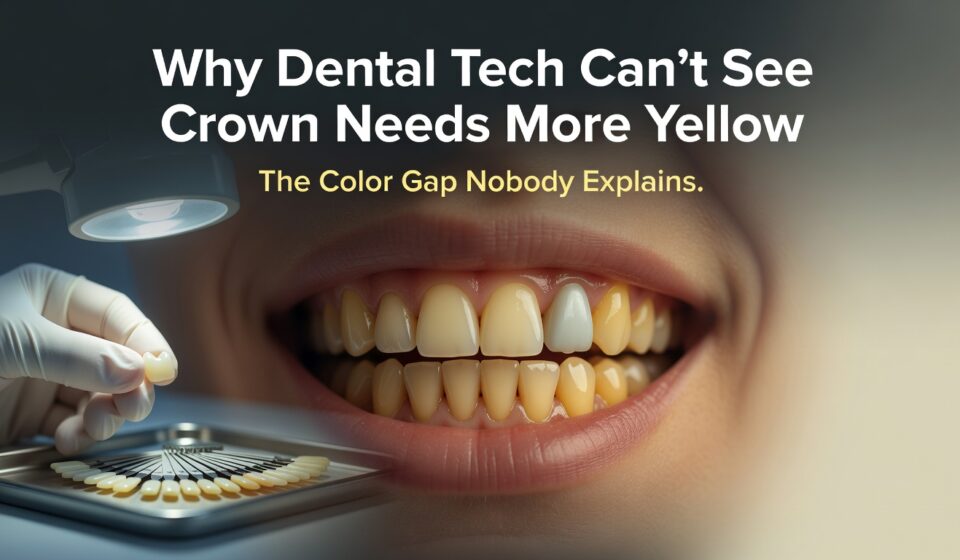

You sit in the dentist’s chair. The crown goes in. Something feels off it looks too pale, too flat, almost gray against your other teeth. The dentist frowns and says it needs more yellow. And somewhere in the back of your head you think: how did the dental technician not catch this?
You’re not the only one who’s thought that. The question of why dental tech can’t see crown needs more yellow comes up constantly during crown try-in appointments, and the answer is less about missed mistakes and more about how color actually works in labs, in mouths, and in human vision.
Natural Teeth Are Not Just “White”
This is the part most people don’t know going in. Real teeth aren’t a single color. They have layers dentin underneath, enamel on top, and the enamel is slightly translucent. Dentin is naturally yellow. The older you get, the thinner your enamel becomes, and the more that warm yellow tone comes through.
So when someone says a crown needs more yellow, they’re not describing an accident. They’re describing the crown missing the warmth that makes teeth look alive instead of artificial. A crown that’s too cool or too white reads as fake even if it technically “matches” the shade guide used to make it.
That’s the first problem. The shade guide tells the lab what color to start from. It doesn’t tell the full story.
Why the Lab Can’t See What the Dentist Sees
Here’s the core of why dental tech can’t see crown needs more yellow: the technician never sees the crown in your mouth.
They work from impressions, written notes, and photos. They fabricate the crown under controlled lab lighting consistent, neutral light designed for technical accuracy. That lighting is not your kitchen, not a restaurant, not the operatory where your dentist works. It’s designed to minimize variables, which also means it strips out the subtle warmth that shows up in real-world conditions.
When that crown goes into your mouth, everything changes. Natural saliva adds a layer of reflectivity. Your gum color bleeds into the visual field. The neighboring teeth with all their individual color gradients sit right next to the new crown. And suddenly the crown that looked fine on a lab bench looks cooler, grayer, flatter than anything else in your mouth.
The technician didn’t miss it. They literally couldn’t see it, because the conditions that reveal it don’t exist in a dental lab.
The Photo Problem Nobody Talks About
Photos are how most of the color communication between dentist and lab happens. The dentist takes a shade photo, writes some notes, and sends it over. But photos introduce their own distortions.
Bright operatory lights wash out yellow tones. Camera flash does the same thing it tends to make teeth look whiter and cooler than they are in person. If the photo is taken under those conditions, the technician is working from inaccurate information through no fault of their own.
Even a well-taken photo is still a 2D image on a screen. Color rendering varies by monitor. What looks warm on one screen looks cool on another. The technician is making judgment calls based on imperfect data, and the final test how the crown actually looks inside a living mouth can’t happen until try-in.
This is a structural limitation of the process, not a skill gap.
Shade Guides Are a Starting Point, Not a Verdict
The shade guide matching process happens at the dentist’s office, usually before impressions are taken. The dentist holds up guide tabs next to the patient’s teeth and selects the closest match. That selection goes to the lab as the reference.
But shade guides have real limits. They don’t account for:
- The color gradient within a single tooth (roots are often darker, incisal edges lighter)
- How translucency behaves under different light sources
- The way adjacent teeth reflect color onto each other
- Subtle warmth differences between teeth of technically the same “shade”
A crown can match the shade guide exactly and still look wrong next to real teeth. The guide is a shorthand. It doesn’t capture the full complexity of what your mouth looks like.
Why Front Teeth Are the Hardest to Match
Back molars have some forgiveness. Nobody’s inspecting them under a light. Front teeth are a different situation entirely.
The upper front teeth sit in the most visible part of your mouth. They catch light from multiple angles. They reflect off your lips. They’re compared against adjacent teeth constantly. Any color discrepancy a crown that’s slightly too gray, slightly too flat, slightly missing that warm yellow undertone shows up immediately.
That’s why the need for more yellow comes up most often with anterior crowns. It’s not that labs do worse work on front teeth. It’s that front teeth expose every imperfection that a back molar would hide.
What Happens After the Dentist Notices
When a crown needs more yellow after try-in, the dentist documents it and sends the crown back to the lab. That feedback usually includes revised notes and new photos taken under better conditions sometimes with comparison shots next to the adjacent teeth.
The technician then adds warmth by layering additional ceramic color or adjusting staining. This is normal. It’s not a redo, it’s a refinement. High-end ceramic work often requires at least one adjustment pass before the shade is right.
Color adjustment after try-in is part of the process, not evidence that something went wrong the first time.
What Patients Can Actually Do
You have more influence here than most people realize.
Being present and engaged during shade selection makes a difference. If something looks off at that stage even a gut feeling say something. Your dentist can’t read your mind, and small concerns raised early are easier to address than ones raised after the crown is seated.
During the try-in, trust your eye. You’ve looked at your own teeth your whole life. If the crown doesn’t look right to you, that’s worth saying. The dentist evaluates it clinically, but you’re the one who has to live with it. A crown that looks artificial or too pale in normal light is a legitimate concern, not a cosmetic complaint.
Crown Color Matching Is Part Science, Part Judgment
There’s no fully automated, always-accurate way to transfer tooth color from a patient’s mouth to a dental lab and back. The tools available shade guides, photos, written descriptions are useful but imperfect. The lab does its best with the information it gets. The dentist evaluates in conditions the lab never sees.
That gap is why dental tech can’t see crown needs more yellow even when they’re doing everything right. It’s not about anyone failing. It’s about what’s visible where, and when.
When more yellow is needed, it’s the system catching what it always catches late the things that only show up in real life.
Frequently Asked Questions
Why dental tech can’t see crown needs more yellow in the lab?
The technician works under controlled neutral lab lighting and never sees the crown inside the patient’s mouth. The warmth differences that appear under natural light, next to real teeth, simply aren’t visible in that environment.
Is yellow color in teeth normal?
Yes. The inner layer of a tooth (dentin) is naturally yellow. As enamel thins with age, this warmth becomes more visible. A crown that lacks yellow often looks too cool or artificial compared to natural teeth.
Can photos sent to the lab cause color errors?
Absolutely. Bright operatory lights and camera flash tend to wash out yellow tones, making teeth appear whiter and cooler in photos than they look in person. The lab fabricates based on that photo, so the distortion carries through.
Does needing more yellow mean the lab made a mistake?
Not usually. Crown color matching involves many variables that can’t all be controlled in the lab. Shade adjustments after try-in are a routine part of getting the result right.
What should I do if my crown looks too pale or gray during try-in?
Say something immediately. The dentist can send it back to the lab for a warmth adjustment. This is far easier to address before the crown is permanently cemented.
Why are front teeth harder to match than back teeth?
Front teeth are visible from multiple angles, sit under direct light, and are constantly compared against neighboring teeth. Any color discrepancy is immediately obvious in a way that a back molar’s mismatch simply isn’t.
Can crown color be adjusted without making a new crown?
Often yes. The lab can add ceramic layers or adjust staining to increase warmth. A full remake is only necessary when the shade difference is too large to correct with surface modifications.
How can patients help improve crown color accuracy?
Being engaged during shade selection, raising concerns early, and giving honest feedback during try-in all help. You know your smile better than anyone that knowledge is genuinely useful at every stage of the process.